

My Advocating For Change (AFC) project was a hugely anticipated one in my school. It served as a capstone project designed to conclude our journey through middle school. This project not only allowed us to showcase our knowledge and skills but also provided an opportunity to present and advocate for a problem or solution that we are deeply passionate about.
I chose to advocate for increased investment and involvement in space-based solutions to combat climate change in the United States, a pressing issue that demands our immediate attention. Throughout my presentation, I elaborated on the various innovative solutions that space technology can offer, such as Space-Based Solar Power (SBSP), which harnesses solar energy from above the Earth’s atmosphere, providing a clean and virtually limitless energy source. Additionally, I discussed how satellite technologies can enhance our understanding of climate patterns, monitor environmental changes, and improve disaster response, all of which are crucial in our fight against climate change. By connecting these advanced technological solutions to real-world applications, I aimed to inspire my peers and teachers to recognize the importance of investing in space-based initiatives as an effective approach to addressing one of the most significant challenges of our time.
I first started by researching the sectors that contribute to greenhouse gas emissions. Surprisingly, the electricity sector is the second-largest contributor to greenhouse gas emissions in the US, accounting for a significant portion of the overall emissions. This sector includes a variety of energy sources, each with its own environmental impact. Fossil fuels, such as coal and natural gas, are primarily responsible for these emissions, as their combustion releases large amounts of carbon dioxide into the atmosphere. Moreover, the continued reliance on these non-renewable energy sources highlights the urgent need for a transition to cleaner alternatives, such as wind, solar, and hydroelectric power. The shift towards more sustainable energy production not only has the potential to reduce greenhouse gas emissions but also to foster economic growth and job creation in the renewable energy sector.
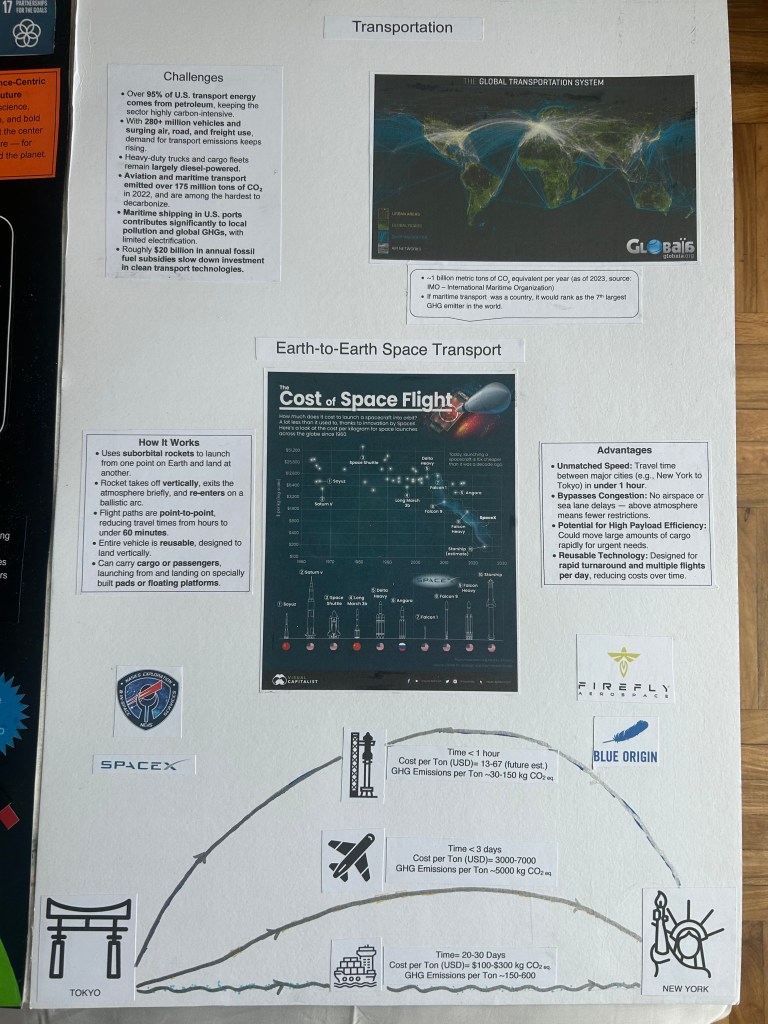
After researching the causes, I explored space-based solutions that could contribute to reducing emissions in the US, particularly in the context of climate change and the urgent need for sustainable energy alternatives. I found many solutions, but three powerful ones stood out to me: Space-Based Solar Power, Earth-to-Earth transport, and in-space manufacturing. Space-Based Solar Power (SBSP) harnesses solar energy and transmits it back to receiving stations on Earth by converting the energy into microwaves, which can then be converted back into electricity for widespread use. This innovative approach not only captures the vast energy available in space without atmospheric interference but also offers a continuous power supply, unaffected by day-night cycles or weather conditions. In addition to this, Earth-to-Earth transport solutions are being developed to efficiently move goods and materials while minimizing carbon footprints, and in-space manufacturing is paving the way for creating products in orbit, reducing the need to launch materials from Earth altogether. Together, these advancements could significantly revolutionize how we approach energy and resource management on our planet.
After conducting thorough research into the topic, I carefully organized my findings in a visually engaging trifold (see the above pictures), which provides a concise overview of the key points. In addition, I prepared a speech to effectively appeal to students, teachers, and parents, highlighting the significance of the subject matter.
Working on this project was more than just a school assignment. It was an opportunity to explore and enhance my knowledge of a topic that I deeply care about. It challenged me to think critically, expand my research skills, and communicate ideas that not only matter to me but also to the future.
 Cosmic Quills
Leave a comment